Team building
Your whole company.
One room. One scoreboard.
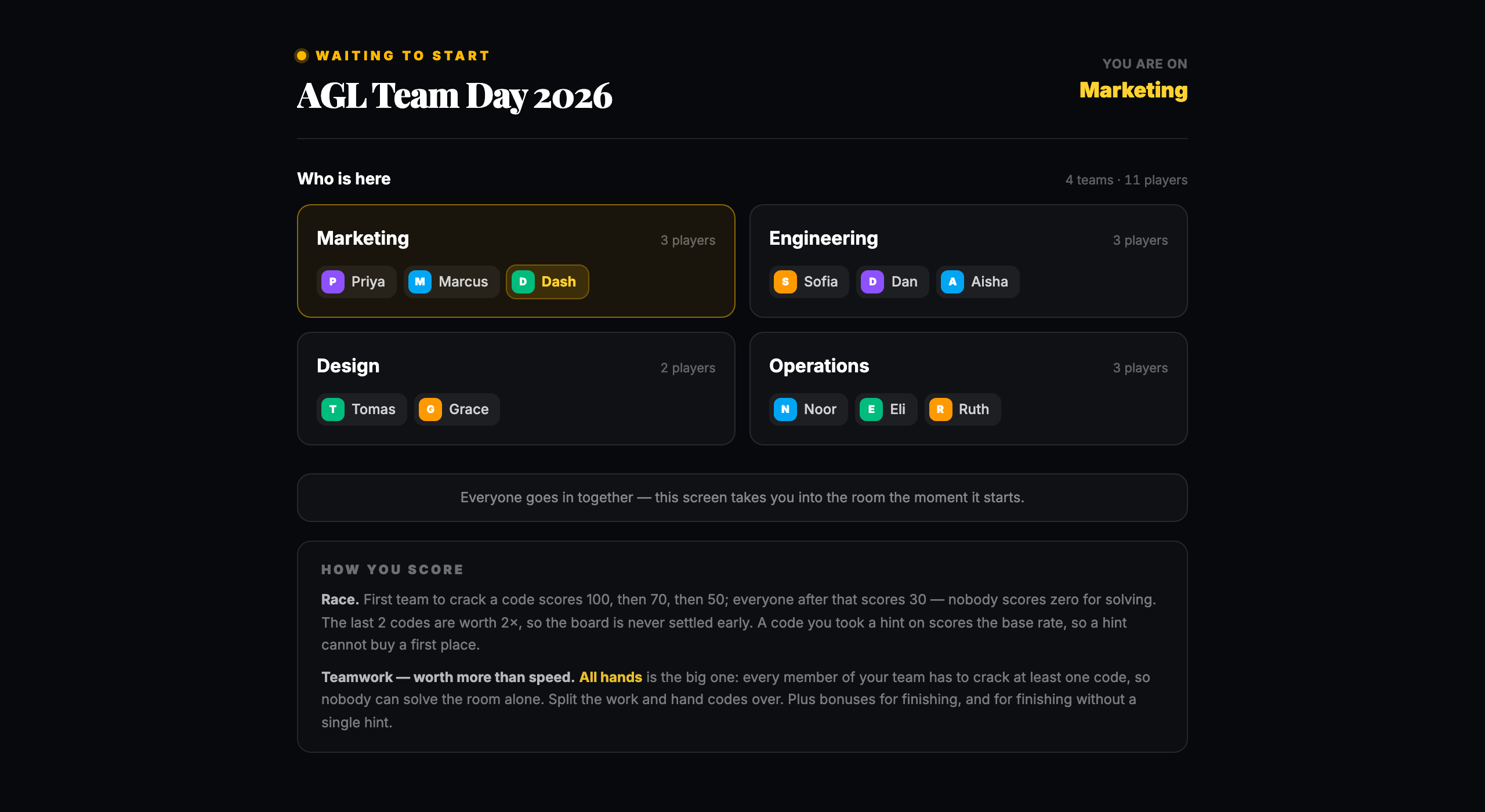
Every team plays the same escape room at the same time, ranked live on one board everybody can see. There is a winner at the end, and an actual ending — not a call that peters out.

Everyone waits in the lobby until you start, so no team gets a head start. Eleven people here, and not one of them made an account.
Why not just buy a few subscriptions?
You could. 28 rooms and multiplayer cost $2.99 a month per group of 6, and for a team of eight having a good time on a Friday that is the right answer. We would rather tell you than have you work it out afterwards.
What it cannot do is put those groups in the same competition. Separate groups cannot see each other, cannot be ranked against each other, and there is no winner — so forty people have eight separate afternoons instead of one. Everything below exists to solve that, and nothing else.
How it runs
1
Everyone joins with a code
Five characters on a slide. No accounts, no installs, no app — a browser is the whole requirement.
2
You start it, together
Teams wait in a lobby and are let in at the same second, so nobody gets a head start reading ahead.
3
The board decides it
Every code cracked moves the board live. It ends when the last team is out, or when you end it.
It does not reward the fastest person in the room
The largest bonus on the board is All hands: every member of a team has to crack at least one code. One person cannot solve the room while four watch — to win it, the quickest solver has to hand a code over and explain what they worked out. That is the exercise you are actually buying.
Nobody scores zero for solving
Fourth team to crack a code still banks points, so no one checks out at the halfway mark.
The last codes are worth double
The board is never settled early. A team behind at the break can still take it.
Hints cost you the lead
A hinted code scores the base rate, so nobody buys first place. You can switch hints off entirely.
You can award points yourself
For the things a scoreboard cannot see — the group that regrouped, the person who unstuck everyone.
How a team actually works together
All hands only means something if a team can split the work, and splitting the work only happens if they can talk and can see what each other has found. Both are built in, which is what lets a team play this from four different cities.
A private chat for each team
Sitting in the corner of the room, open to your team and nobody else. The codes are scattered over five or six pages, so “the stage numbers are on the schedule page, I’ll take the setlist one” is most of what winning looks like. Teams racing each other cannot read it.
Everyone sees the same progress
A code one person cracks appears on every teammate’s screen straight away, so nobody wastes twenty minutes on a puzzle somebody else has already done. When the last code falls, the whole team leaves the room together — even the ones who were reading a different page at the time.
Nobody is left behind
A team that finishes early goes to a lobby showing their placing and the live board, not a dead end. They can watch the teams behind them close in.
It ends by itself
The moment the last team is out, the board is called and the ceremony runs. Nobody has to be watching a dashboard at the right second.
Or you end it
Out of time? Two confirmations and it stops where it stands. The board is still complete and the ceremony still runs.
What it costs
Most companies start here
One event
$400per event
- Any number of people, on one day
- We set it up, start it and run the finish
- Any of our rooms, picked to fit your slot
- Invoiced — no card, no subscription
A week of events
$900for 7 days
- Run as many as you like for 7 days
- Rotate people into different teams each time
- Different room each session, if you want
- Cheaper than two single events, and less work for us
Schools & non-profits
$150per event
- Exactly the same product, no cut-down version
- Built for a class, a club or a staff day
- Ask and it is yours — no forms to fill in
- We would rather it got used than sat idle
For reference, corporate virtual team building usually runs $25–50 a head. A week of events for forty people works out at about twenty-two — and that is the whole week, not one session.
The bigger version
Your company as the room
A fake website built as your company — your products, your offices, the things only people who work there would recognise — with the puzzles hidden across it. This is the part nobody else can sell you, and the part your people will still be quoting a year later.
Published
$1,500from
Your room goes into the public library, under your name, where anybody playing the site can find it. Cheaper because it is worth something to us too — and it puts your company in front of people who came here to play.
Private
$2,500from
Yours alone. Never listed, never shown to anybody outside your company. The right answer if the room would give away anything you would rather it did not.
How it works
- You fill in a short brief: how many puzzles, how hard, what your company does
- And the good bit — the inside details worth hiding a puzzle in
- You see the puzzles written out before they are built, and can veto any of them
- One round of changes once it is up, included
- At least 14 days from the brief to running it
- Includes running your first event on it
Yours afterwards
- Run it again whenever — onboarding, recruiting days, next year's offsite
- No per-use fee and nothing to renew
- We keep it working as the site changes
- Say the word and we take it down for good
Simpler builds can move faster than 14 days — tell us the date you are working towards and we will tell you honestly whether it fits.
What you get
On the day
- A five-character code your people type in — that is the whole setup
- A lobby that holds everyone until you start, so all teams begin together
- A live board for the projector, updating the second a code falls
- A private chat for each team, and shared progress across their screens
- A closing ceremony that names third, second and the winner
- It ends itself when the last team is out — or you end it early
For you, running it
- One dashboard: every team, who is on it, how far they have got
- Award bonus points by hand for anything the scoreboard cannot see
- End it early with two confirmations, if you run out of time
- Hints on or off, decided before you start
- Decide whether people can make their own teams, or only join yours
What your people need
- A browser. Phone, laptop, tablet — all fine
- No account, no sign-up, no app, no download
- No prior experience; the rooms teach themselves
- They can be in one office, six offices, or at home
What you do not get
- A facilitator on a video call reading from a script
- A per-person licence to chase up afterwards
- Anything to install on company machines
- A subscription that renews until somebody cancels it
Which room, and how long
28 to choose from, and we will pick one to fit the slot you actually have rather than the one you wish you had.
30–40 minutes
A lunch hour with time to talk afterwards. Best for a first one, and for a group that has never done this.
45–60 minutes
The usual choice. Long enough that teams have to organise themselves rather than just move fast.
60–75 minutes
For groups that have done one before and want to be properly beaten by it.
How buying it works
No card, no plan, nothing that renews. You tell us a date, we invoice you, and event hosting is switched on for one account at your company — whoever is going to run it.
One event
Switched on until you have run your event. Take a week to schedule it if you like — it is one event, not one day.
A week of events
On for 7 days from the day you start. Run as many as you want inside that.
Custom room
The room is yours permanently, and hosting stays on for it. Nothing to renew.
The person running it needs a free account so we know where to switch it on. Everybody playing needs nothing at all.
The plain facts
- How long is it?
- Most rooms run 30–70 minutes. We will pick one to fit the slot you have, and you can end it early without breaking anything.
- Does anyone need an account?
- No. Players type a five-character code and their name. Nothing to install, nothing to sign up for, works on a phone.
- Remote, in person, or both?
- All three. Teams do not have to be in the same room, or the same country — the board is the shared part.
- How many people?
- Up to 100 teams of 100. Real numbers, not "unlimited". Groups of four to six play best.
- What if somebody joins late?
- They join and go straight in. Teams that finish early wait in a lobby watching the board, not staring at a wall.
- Who is behind this?
- A small independent studio that has built 29 of these rooms. You will be talking to the person who makes them, not an account manager.
Ask about a date
Tell me roughly how many people and roughly when. If it is not a fit I will say so — it is a small operation and a bad booking costs me more than it costs you.
Goes straight to a person. No sales sequence, no calendar link.
Escape The Website · 28 rooms · play one free